Home office
Whether it’s a dedicated study or a desk in the corner: a well-designed workspace helps you focus and makes evenings more relaxing. Here are ideas for home offices and studies – including small flats.
Living:Living room decoration ideasDining room & table decorKitchen decoration ideasHallway decoration ideas
The right spot
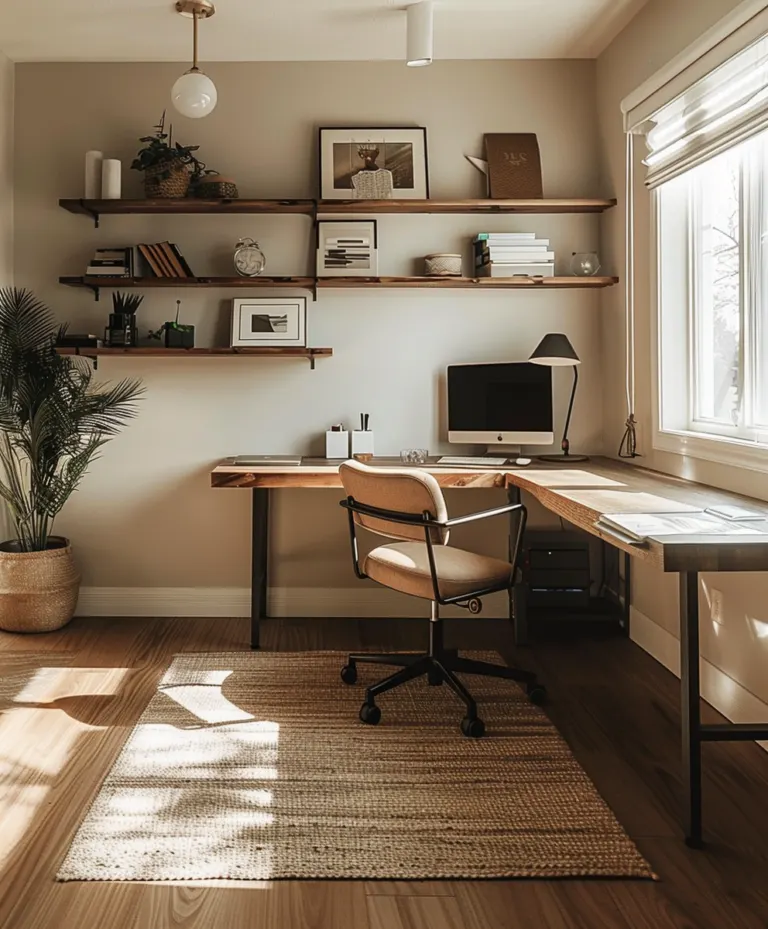
The best place for a desk is side-on to the window: daylight falls on the work surface without dazzling you or reflecting on the screen. With your back to the window the screen reflects; facing it, you’re dazzled. If you don’t have a separate room, look for a quiet corner away from the TV and walkways.
Desk and chair
- Desk height: 72–75 cm for most people; a height-adjustable desk lets you switch between sitting and standing.
- Depth: at least 70 cm, so the screen is far enough away (about an arm’s length).
- Width: 120 cm is enough for a laptop and papers, 160 cm for two monitors.
- Chair: adjustable seat height, lumbar support, armrests at desk height. A good chair is the most important investment.
Lighting
A workspace needs more and brighter light than living areas: a desk lamp at 3,000–4,000 Kelvin with high colour rendering, plus even ambient light in the room. If you work at a screen a lot, a monitor light bar or indirect light behind the monitor helps. More in our guide Kelvin check.
Order at the desk
- Hide cables: a cable tray under the desk, a box for chargers.
- Digitise paper: once it’s scanned, it can go into the file in the cupboard.
- Filing system: one tray for incoming, one for done.
- Tidy up in the evening: an empty desk helps you switch off.
Ideas for a calm look in minimalist office decor.
Home office in the living room or bedroom
Without a separate room, switching off is harder. What helps:
- A bureau or fold-down desk that closes after work.
- A room divider – shelf, curtain or folding screen – separates work and living. Ideas in room divider ideas.
- Work materials in a box that goes into the cupboard in the evening.
- In the bedroom: position the desk so you can’t see it from the bed.
Design that does you good
A workspace may be beautiful: a plant, a picture, a pleasant wall colour. Shades of green are considered calming and good for concentration – ideas in how to combine sage green. A rug dampens sound; curtains or acoustic panels help with video calls. How panels work: wall panel ideas.
Video calls
For video meetings, check your background: a shelf with books and a plant rather than a clothes airer. Light from the front (a window or lamp behind the screen) makes your face look friendly.
Frequently asked questions
Where is the best place for a desk?
Side-on to the window, so daylight falls on the desk without dazzling you or reflecting on the screen.
How high should a desk be?
For most people 72–75 cm. A height-adjustable desk for switching between sitting and standing is ideal.
What lighting does a workspace need?
A desk lamp at 3,000–4,000 Kelvin with high colour rendering plus even ambient light.
How do I separate home office and living space?
With a room divider, a closable bureau and a box for work materials that disappears in the evening.
Which wall colour suits a study?
Calm, light tones; greens like sage are considered good for concentration.