
Introduction: Why Light Color is Crucial for Your Well-being
Light is far more than just a means to see in the dark. It significantly influences our mood, our ability to concentrate, and even our biological rhythm. If you’ve ever worked in an office with harsh, bluish light or sat in a cozy living room by candlelight, you know how different the atmosphere can be. The decisive factor here is the color temperature, measured in Kelvin (K). In this comprehensive guide, you will learn everything about the Kelvin check and which light belongs in which room.

What does Kelvin actually mean?
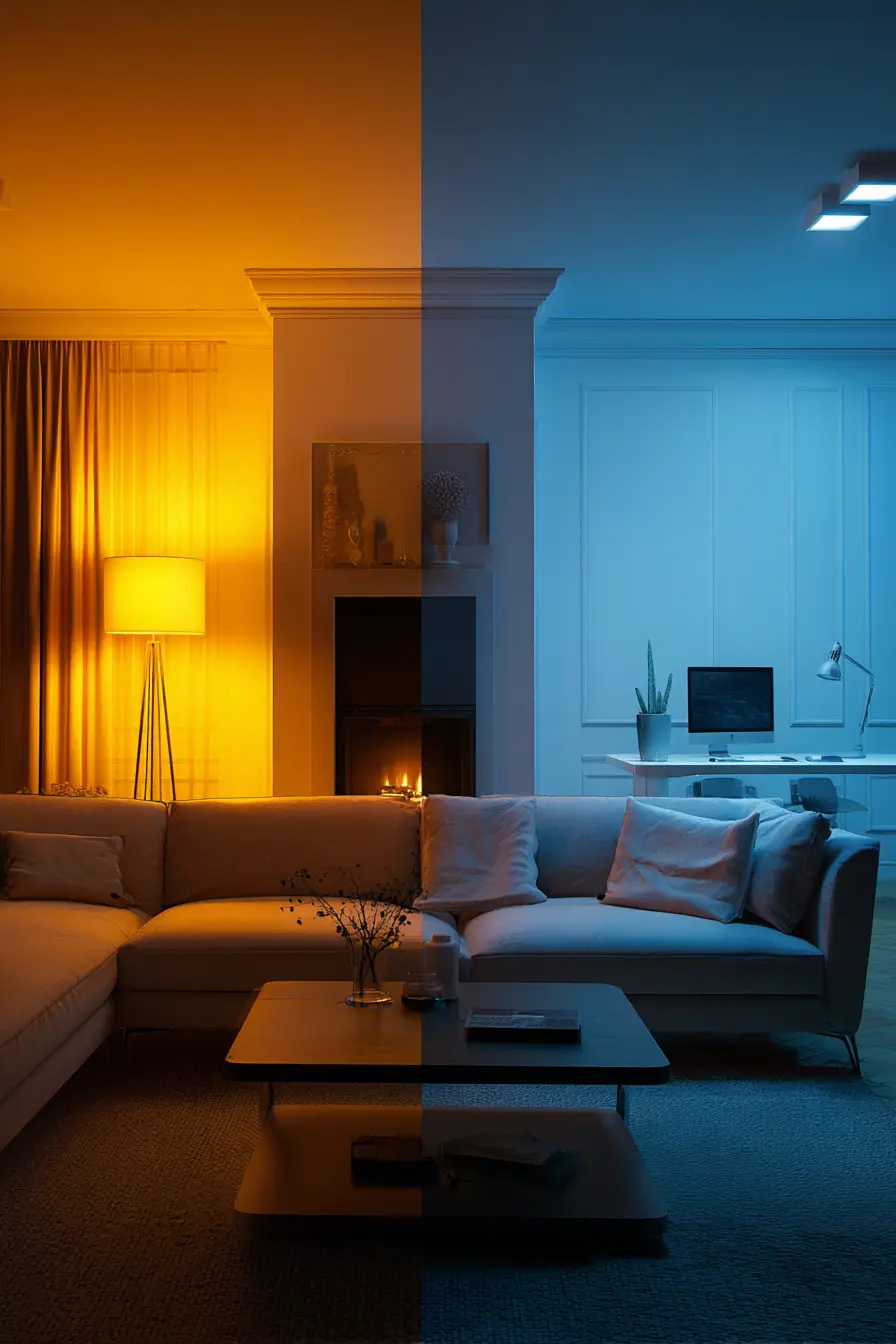
The unit of measurement Kelvin indicates the light color of a light source. Technically, this is based on the principle of a “black body radiator” that is heated and glows in different colors depending on the temperature. Low Kelvin values (approx. 1,500 K to 3,000 K) represent warm, reddish-yellow light, similar to a flame or a classic light bulb. High Kelvin values (above 5,000 K) represent cool, bluish light that resembles daylight. Choosing the right color temperature determines whether a room feels inviting, functional, or activating.
The Three Main Categories of Light Colors
Before we look at the individual rooms, we need to understand the three basic categories into which light sources are divided:
- Warm White (2,700 K to 3,300 K): This light feels cozy, relaxing, and homely. It is reminiscent of the evening sun and promotes the release of melatonin, which helps us to rest.
- Neutral White (3,300 K to 5,300 K): A “matter-of-fact” light that makes details clearly visible without appearing too cool. It promotes alertness and is excellent for activities.
- Daylight White (> 5,300 K): This light has a high blue component and has an activating effect. It increases concentration and performance as it is modeled on natural midday light.
The Room-by-Room Guide: Where does which light go?
1. The Living Room: Pure Relaxation (2,700 K – 3,000 K)
The living room is the place for recovery and social gatherings. Here, Warm White is an absolute must. A value of 2,700 K creates a comfortable atmosphere that is ideal for movie nights or conversations with friends. Tip: Work with different light sources. A central ceiling light can be slightly brighter (3,000 K), while floor lamps and accent lighting with 2,200 K to 2,700 K provide the necessary coziness.
2. The Bedroom: Preparing for the Night (2,500 K – 2,700 K)
In the bedroom, we want to find peace. Since blue light inhibits the production of the sleep hormone melatonin, you should opt for very warm light here. Values between 2,500 K and 2,700 K are ideal. If you read in bed, a separate reading lamp with approx. 3,000 K is recommended to avoid straining your eyes while the rest of the room stays in warm slumber mode.
3. The Kitchen: Functionality meets Ambience (3,000 K – 4.000 K)
The kitchen is a place for work, but often also for eating. Therefore, a combination makes sense. For the work surfaces (under the wall cabinets), Neutral White (approx. 4,000 K) is ideal as it renders contrasts sharply and increases safety when cutting. For general lighting or the dining area, 3,000 K (Warm White) is more pleasant to create an inviting atmosphere.
4. The Bathroom: From Wellness to Precision (3,000 K – 5,000 K)
In the morning, the bathroom is a functional zone; in the evening, it’s a wellness area. For applying makeup or shaving at the mirror, light with 4,000 K to 5,000 K is best as it reproduces colors accurately and minimizes shadows. However, for a relaxing bath in the evening, warm light (3,000 K) is preferable. Solution: Dimmable lights or smart home systems that can adjust the color temperature.
5. The Home Office: Maximum Concentration (5,000 K – 6,500 K)
To work with focus, you need Daylight White. Light colors from 5,000 K act as a biological wake-up call. They suppress fatigue and promote cognitive performance. However, make sure to turn off this light in time in the evening so as not to disturb your sleep rhythm.

Technical Aspects: Color Rendering (CRI) and Smart Lighting
In addition to the Kelvin number, the CRI value (Color Rendering Index) is crucial. It indicates how natural colors appear under the light. A value of Ra > 80 is standard; for bathrooms and kitchens, you should look for Ra > 90. Nowadays, smart home solutions offer the possibility of dynamically adjusting the color temperature (Human Centric Lighting). This way, you have activating cool light in the morning and automatically soothing warm light in the evening.
Conclusion: It’s All in the Mix
There is no such thing as the “one” perfect light for the whole house. The art lies in layering and adapting to the room’s use. While the home office demands cool objectivity, the living room needs the warmth of a sunset. Use the Kelvin check to not just light your rooms, but to stage them.
Frequently Asked Questions
What is the difference between warm white and cool white?
Warm white (2,700K-3,300K) has a yellowish hue and feels cozy. Cool white or daylight white (>5,300K) has a bluish component and is stimulating and conducive to concentration.
What Kelvin number is best for reading?
For reading, neutral white light around 3,000 K to 4,000 K is recommended. It provides enough contrast for text without tiring the eyes too quickly due to high blue light levels.
Can the wrong light make you sick?
Permanently wrong lighting can disturb the circadian rhythm. Too much blue light in the evening leads to sleep disorders, while light that is too dark and warm at the workplace can strain the eyes and cause headaches.
Are LED bulbs available in all Kelvin stages?
Yes, modern LED technology covers the entire spectrum from extra-warm 1,800 K to cool 8,000 K. Many LEDs are also adjustable in color temperature (Tunable White).
What does ‘Tunable White’ mean?
Tunable White refers to light sources whose color temperature can be continuously adjusted from warm white to daylight white, often via an app or remote control.
Which light is best for applying makeup?
For makeup, neutral white (approx. 4,000 K to 4,500 K) with a high color rendering index (CRI > 90) is ideal, as it is closest to daylight and represents colors realistically.
Why do 6,000 Kelvin feel uncomfortable in the living room?
6,000 K corresponds to midday light under a cloudy sky. It feels sterile and “clinical,” which contradicts the human need for security and comfort in relaxation zones.

- Minimalist Kitchen Decor: Less is More for Your Kitchen – 13. January 2026
- Modern Kitchen Decor: 7 Stylish Ideas for Your Kitchen – 12. January 2026
- Living Room Decor for Rental Apartments: Creative and Stylish Ideas – 7. January 2026









0 Comments